Essential
Everything you need to get started.
Starting from€299
Included
Get a quote - Data logger rental
- Calibrated data loggers
- Calibration certificates
Commissioning a new GMP facility, preparing an EMA, FDA or MHRA inspection, or under change control after an HVAC modification? A temperature mapping study by Temperature Mapping Europe provides the Annex 15-aligned OQ/PQ evidence your Qualified Person and auditors expect, for production rooms, climate and stability chambers, cold rooms 2-8 °C, and freezers down to -80 °C.
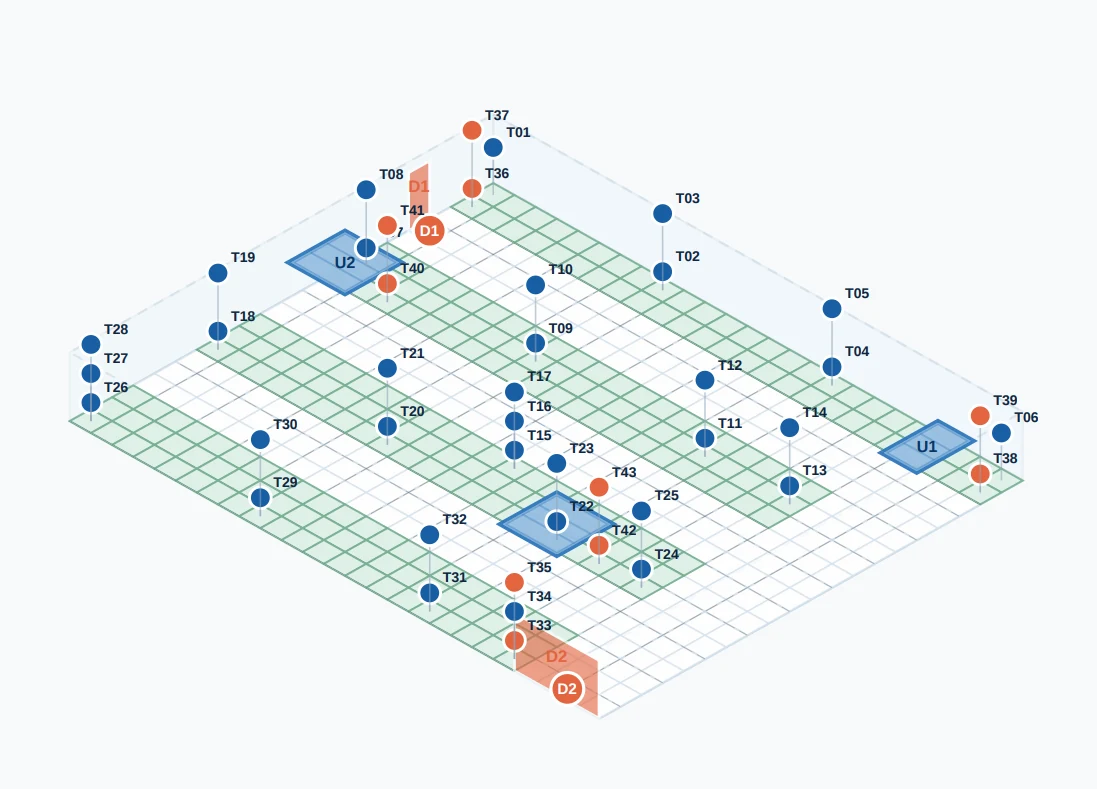
GMP temperature mapping is a documented qualification study that measures whether every product location and worst-case position inside a production room, climate chamber, cold room or freezer stays within its required temperature range under representative loading. The study provides Annex 15-aligned OQ/PQ evidence, identifies hot and cold spots, justifies the fixed monitoring probe position and alarm limits, and traces acceptance criteria back to the URS and forward to the routine monitoring plan.
A mapping study is not an end in itself. It exists to give the Qualified Person and the inspector a well-supported answer to the three questions that come up in almost every GMP inspection of a controlled temperature environment.
Annex 15 requires a documented chain from user requirements, through OQ in the unloaded state and PQ under representative loading, to routine monitoring. The mapping dossier makes that chain explicit: the URS states the required temperature range, the protocol translates it into acceptance criteria with justified guard band, and the report shows every product location compliant with specification. A less complete evidence chain can appear as a gap in the qualification lifecycle.
An empty-chamber OQ demonstrates intrinsic uniformity but says little about production reality. A stability chamber loaded with product to 80 percent shelf capacity, a cold room after a full pallet delivery, a production room during peak occupancy: that is where temperature excursions occur. Mapping under representative loading is the PQ evidence that inspectors ask to see, and where CAPA is initiated when acceptance criteria are not met.
Without mapping, the monitoring probe usually sits where the OEM technician placed it, and the alarm limits are derived directly from labelled storage limits, with no additional margin. Mapping replaces both with data: the probe is placed at the actual worst-case position, or the existing position is justified using the mapping data, and alarm limits include a guard band derived from measurement uncertainty and mapping variability. That is what a QP signs off on, and what an inspector wants to see documented.
The three questions above are the start. Our free audit-readiness check runs your temperature-mapping and monitoring documentation past the points that GMP and GDP inspectors actually examine, tailored to your room type: production room, climate chamber, cold room, freezer or ULT. In five to ten minutes you receive a PDF report showing where your file is strong, and where an inspector might raise a finding.
Grounded in EU GMP Annex 15, the revised Annex 1 (2023), ICH Q9/Q10, WHO TRS 961 Annex 9 and the ISPE Good Practice Guide: Controlled Temperature Chamber Mapping and Monitoring, plus 37 concrete findings from 58 Dutch GDP/GMP inspection reports.

At Temperature Mapping Europe, your qualification study is handled by professionals with experience both in pharmaceutical quality systems and in the practical execution of qualification protocols under a maintained validation master plan.
We have extensive hands-on experience in quality management within EU-GMP/GDP environments for pharmaceutical manufacturing and distribution. This experience includes serving as a Responsible Person / Designated Person and leading validation and qualification programmes in highly regulated environments. That means the dossier speaks the language a QP, an internal QA reviewer and an EMA, FDA or MHRA inspector expect.
The people assessing your production room, chamber or cold storage come from industry. They understand both ICH Q9 quality risk management on paper and how mapping deviations are actually classified, investigated and closed under CAPA in a working GMP facility.
Temperature Mapping Europe is an independent company, not a manufacturer, distributor or label of any equipment supplier. We sell no monitoring systems of our own and choose data loggers on a brand-neutral basis. Our approach follows ISPE, WHO, GDP, GMP and Annex 15 guidance, independent of any supplier.
The same person defines the measurement setup, executes the study, processes the data and writes the report. That gives you short lines, fast planning and one fixed point of contact for the entire qualification cycle.

The number of loggers, the study duration and the risk zones depend on which storage or processing condition applies, and on the stage of the qualification lifecycle applicable to the space (empty OQ, loaded PQ, or periodic requalification). Below is the typical scope for GMP-controlled temperature environments; the exact plan is defined in the mapping protocol using a risk-based rationale in accordance with ICH Q9, WHO TRS 961 Annex 9 and the ISPE Good Practice Guide: Controlled Temperature Chamber Mapping and Monitoring.
For refrigerated APIs, active substance, finished product, ICH stability samples and biologics. Typical scope for a walk-in cold room or ICH chamber: 9 to 15 measurement points per zone, additional points at the door, evaporator and loading boundaries, over at least a full week per campaign, with both empty (OQ) and loaded (PQ) configurations where the qualification lifecycle requires it.
For controlled production environments, weighing and dispensing rooms, packaging lines, medicinal-product warehouses and cleanrooms with a temperature specification. Typical scope for a European GMP production area: a grid of loggers every 5 to 10 metres at multiple heights, over at least a full measurement week per season, with a documented rationale where a single campaign is used.
Measurement points are selected based on the room type, GMP class, acceptance criteria from the URS, loading pattern and the qualification question the dossier must answer.
A pharma mapping dossier should make it clear why the study design was logical, how the URS and acceptance criteria drive the protocol, what the data show under real loading, and how routine monitoring and alarm limits follow from the results. That chain is what a QP signs and what an inspector reads.
"The loaded PQ made the sensor position well-supported in front of both our QP and the MHRA auditor. The alarm-limit guard band was traceable to the uncertainty of the mapping results, no assumptions."QA Manager, sterile manufacturing site
Before requesting a quote, use the free 3D mapping tool to sketch your production room, cold room, climate chamber or freezer. You get a proposed sensor layout, an estimated number of loggers and a first indication of the study scope, so the consultation starts with a concrete picture instead of a blank protocol page.
In GMP-relevant environments, temperature mapping is not a one-off action. Changes, audits and periodic requalification make mapping part of the regular qualification cycle.