What the guidelines say about logger placement
The guidelines rarely tell you an exact number of loggers per square metre. What they do provide is the logic for why a measurement point matters. That is where the sources line up.
EU GDP 2013/C 343/01 calls for an initial temperature mapping before use under representative conditions. It then expects fixed monitoring equipment to be placed on the basis of the mapping results, at the points showing the greatest fluctuations.
WHO TRS 961 Annex 9 Supplement 8 looks at mapping spatially: doors, windows, exterior walls, evaporators, airflow, storage height and product zones all influence placement. That WHO guidance is primarily written for storage areas, cold rooms, freezer rooms and other larger temperature-controlled areas, not for small fridges or compact freezers.
EU GMP Annex 15 emphasises a predefined measurement set-up, acceptance criteria and change control. For logger placement, that means the plan should be justified before execution and any later change should remain traceable.
ISPE translates this into a lifecycle and risk-based approach. Not every position matters equally. You look at product storage locations, worst-case positions, air distribution, recovery after door opening and the question of which fixed monitoring position should support routine monitoring later on.
Where does a logger almost always belong?
A measurement point is most useful when it helps you assess a real product risk or a known risk area. The table below is a practical starting point.
| Zone or factor | Why it matters | Placement consequence |
|---|---|---|
| Product locations | Product storage matters more than the empty aisle. | Place loggers where product is actually stored, or will be stored. |
| Doors and loading bays | Warm or cold air ingress and recovery behaviour may differ clearly here. | Add an extra point near the door zone, often on the path of incoming air. |
| High, mid and low levels | Stratification and vertical temperature differences are real in many spaces. | Use multiple heights where storage height or air distribution calls for it. |
| Cooling unit or evaporator | A local colder zone or different air velocity may occur nearby. | Place a point within the zone of influence, without blindly relying on the direct discharge point. |
| Exterior wall or window | Solar gain and outdoor temperature can affect edge zones. | Add edge points at sensitive facades or window areas. |
| Corners and dead zones | Air circulation is often less uniform here. | Use edge or corner points to check low air movement zones. |
| Known deviation areas | Previous excursions or complaints increase the risk. | Add a targeted extra point even if the grid would not place one there. |
| Fixed monitoring position | That location must later support routine monitoring. | Include the intended monitoring zone in the mapping and verify that it makes sense. |
Start with the product, not the empty room
A common mistake is to spread loggers neatly across the floor plan while the product is stored somewhere else. The guidance instead focuses on the temperature around the product you actually store. An empty corner can still matter, but only if that corner is relevant because of storage, airflow or risk.
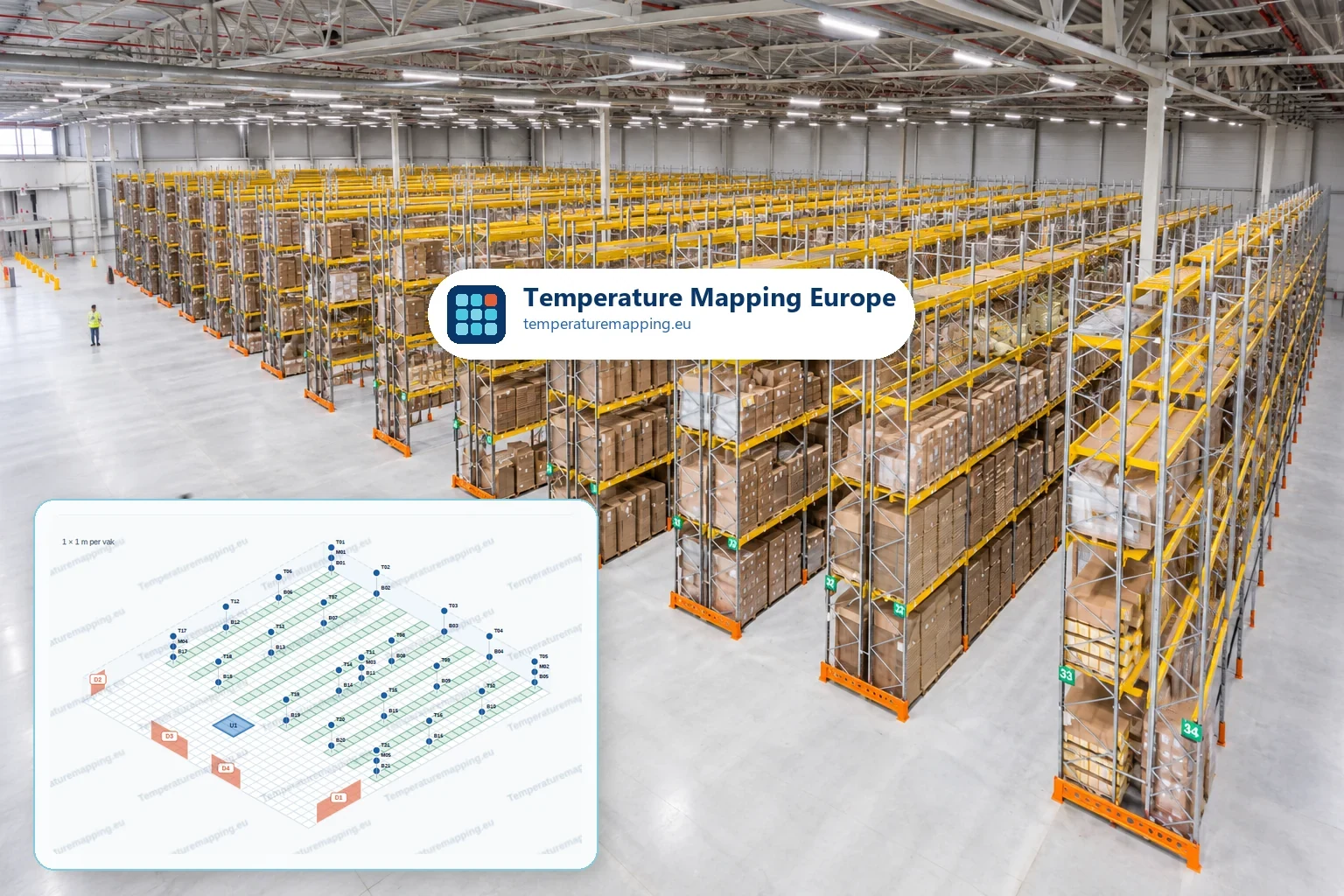
That is why logger placement varies by situation. A tall GDP warehouse with racking needs a different set-up from a pharmacy fridge, a ULT freezer or a cold room with frequent door openings. The core question stays the same: which zones could be warmest, coldest or least stable for the product?
Multiple heights are often necessary
In larger spaces or high racking, temperature differences between low, middle and high positions are not unusual. Warm air rises, cold air sinks and airflow does not always move uniformly across the full space. A single measurement level is therefore often not enough.
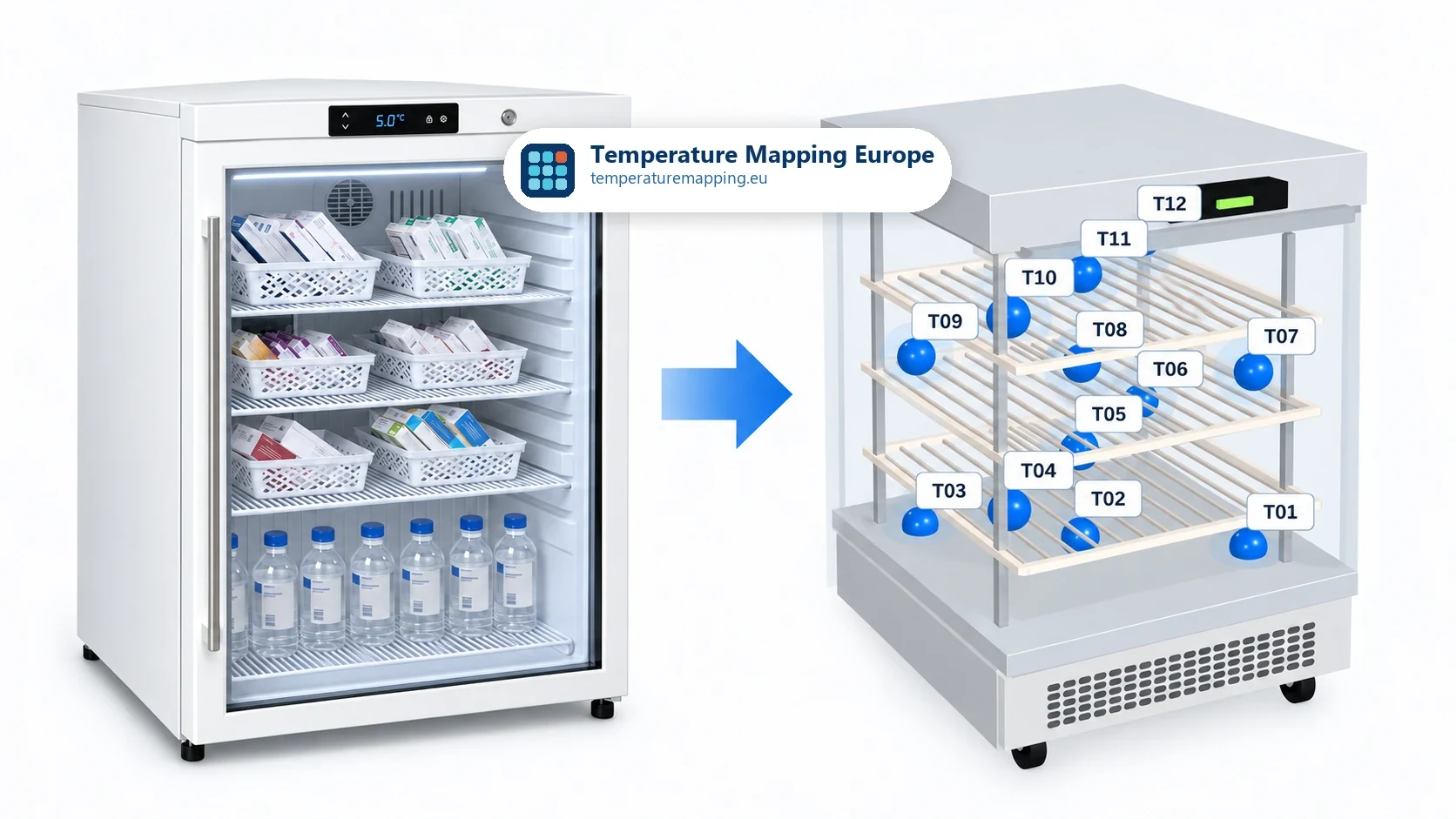
In cold rooms and warehouses, it makes sense to include vertical differences in the protocol. In small fridges or compact freezers, attention often shifts more to the door zone, the back wall, the top shelf, the bottom shelf and the location of the fixed sensor.
How these guidelines support your logger placement
GDP makes clear that fixed monitoring should come out of mapping. WHO helps you read the room spatially: where are the doors, exterior influences, airflow patterns and product zones? GMP Annex 15 requires that the measurement set-up is predefined and that later changes are controlled. ISPE then helps turn those choices into a practical, risk-based set-up.
In practice, that means no guesswork, but a measurement-point plan with a rationale. Not just "one logger near the door", but an explanation of why that door matters, at which height you measure and how that position relates to storage, airflow, use and acceptance criteria.
Want to build a first logger layout yourself?
For warehouses, cold rooms, fridges, freezers and climate chambers, you can use our 3D tool as a starting point for your measurement-point plan. The tool is intentionally a first proposal, not a replacement for an audit-ready protocol.
Start the logger placement tool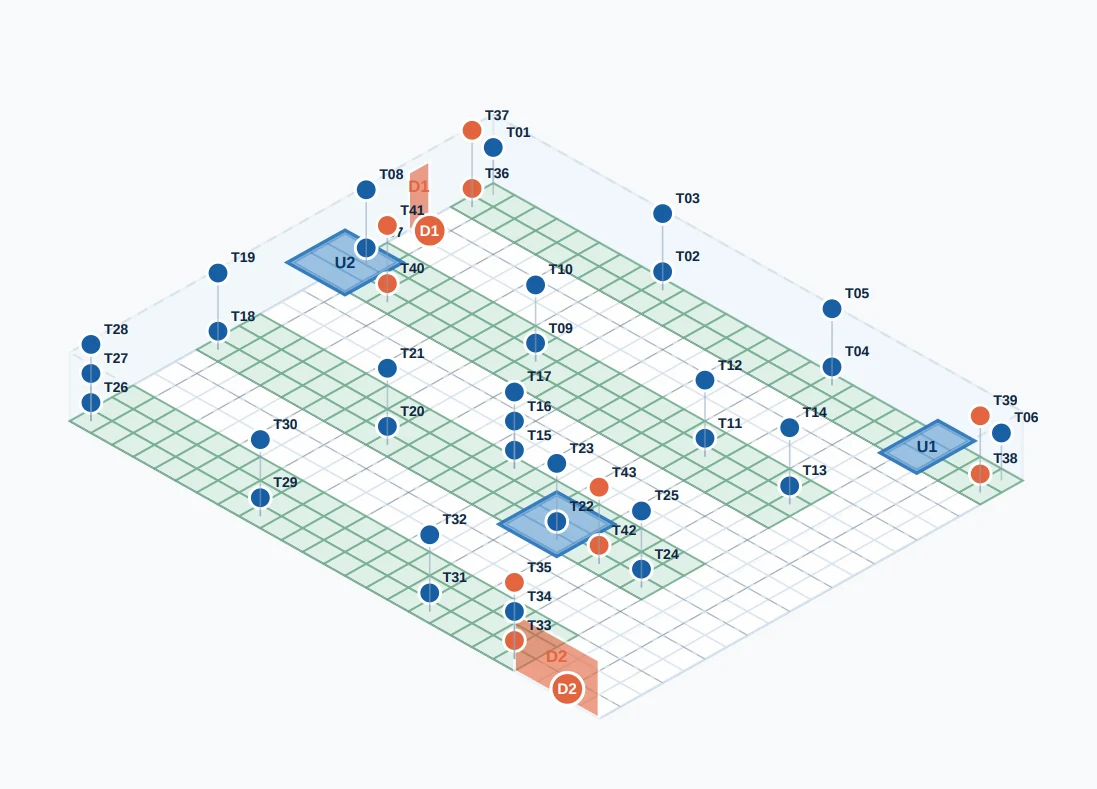
What the tool is meant for
The 3D tool supports both rooms (warehouses, cold rooms, freezer rooms) and appliances (fridges, freezers, climate chambers). For rooms, floor area, height, product zones and risk zones help create a logical first grid. For appliances, the wizard works with shelves, volume and door position.
The wizard automatically adapts its logic per type: a multi-height grid for larger rooms, a shelf-and-volume layout for appliances. The article is intentionally broader than the tool itself.
Common mistakes in data logger placement
- Spreading loggers evenly without checking where product is actually stored.
- Measuring only in the centre and ignoring edge, corner or height positions.
- Underestimating the effect of doors and loading bays.
- Leaving the intended fixed monitoring position out of the mapping.
- Changing measurement points afterwards without updating the protocol or deviation record.
- Treating the tool output as automatically audit-ready without further review.
Sources used
- EU GDP 2013/C 343/01, especially the provisions on initial temperature mapping and monitoring position based on mapping results.
- EudraLex Volume 4, Annex 15: Qualification and Validation, for predefined measurement set-up, acceptance criteria and change control.
- WHO TRS 961 Annex 9 Supplement 8, for temperature mapping of storage areas and assessment of spatial risk positions.
- ISPE good practice guidance for a risk-based assessment of logger locations, air distribution and worst-case zones.