Essential
Everything you need to get started.
Starting from€299
Included
Get a quote - Data logger rental
- Calibrated data loggers
- Calibration certificates
At Temperature Mapping Europe, not every space requires the same approach, and not every organisation wants to outsource the same amount of work. Choose the route that fits your space, your QA responsibility and the support you need: perform the measurement yourself with rented data loggers, perform the measurement yourself with protocol and reporting, or complete on-site execution.
Still unsure about product zones, doors, HVAC units or the number of measurement points? With the 3D measurement point tool you sketch your space visually and receive an initial, risk-based measurement point proposal. After that, it is easier to choose whether to perform the measurement yourself or outsource the execution.
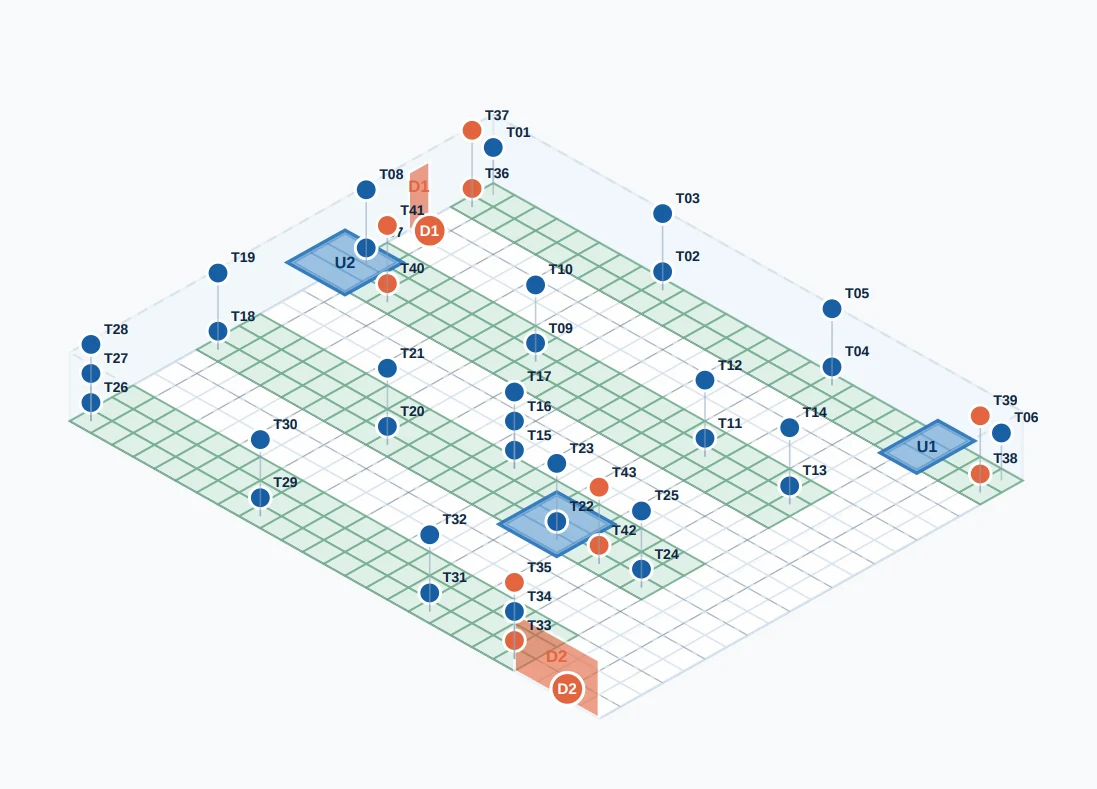
The technical requirements remain the same: measurement points must be justified, loggers calibrated and results traceable. The difference is mainly who performs the measurement, analyses the data and prepares the dossier.
you can prepare the measurement plan, perform the measurement, interpret the results and document the study in-house.
you need an audit-ready protocol, rationale or independent reporting.
your own QA, RP or project owner defines the measurement setup, reviews the data and prepares the dossier.
you can place the data loggers yourself, but want the protocol, rationale, analysis and reporting prepared externally.
you do not have internal capacity for placement, readout or practical coordination on site.
you perform the measurement according to instructions; we justify the setup, analyse the results and deliver the report.
you want to outsource the mapping completely, or the space is complex, critical or audit-sensitive.
you only need standalone data loggers and already have sufficient internal expertise and documentation in-house.
we assess the space, place the data loggers, download the data and deliver the analysis and reporting.
Choose your sector when the quality context is the deciding factor, for example GDP, GMP, hospital storage, pharmacy processes or laboratory equipment.
GMP qualification of production rooms, climate chambers and cold storage for manufacturers and CMOs.
Seasonal mapping and qualification of GDP-regulated warehouses, cold rooms and distribution centres.
Temperature mapping for pharmacy fridges, medicine rooms and ward refrigerators in hospitals.
Ward fridges, medicine rooms and central storage in hospitals and healthcare institutions.
Freezers, incubators, stability chambers and climate chambers for GMP and GLP environments.
Choose your room type when the storage condition or equipment is the deciding factor. This helps you identify the relevant risks, measurement duration and measurement points more quickly.
Racking, doors, airflow and product locations in refrigerated storage.
Controlled room temperature with seasonal and height-related differences.
Hot spots, cold spots and justified sensor placement for small equipment.
Deep-freeze storage where every degree counts and sensor position is critical.
The route may differ, but the core process remains the same: first understand the situation, then define the measurement points, measure and report.
We map your space, limits and risks and choose the right service level.
Measurement points, risk zones and acceptance criteria are documented before you start. The 3D tool can provide an initial proposal.
You perform the measurement yourself with rented data loggers, or we come to your site. In both cases, the report is based on the same principles.
Data, analysis and conclusion in one report, ready for inspection or as an internal quality record.
These questions help you choose between performing the measurement yourself, performing the measurement yourself with protocol and reporting or complete on-site execution. Price details are listed separately on the pricing page.
Use the selector or ask for advice. We will review your space, internal capacity, audit objective and desired level of support.