Essential
Everything you need to get started.
Starting from€299
Included
Get a quote - Data logger rental
- Calibrated data loggers
- Calibration certificates
Facing a pharmacy inspection visit, an internal quality review, or a new medicine refrigerator? A temperature mapping study by Temperature Mapping Europe gives you the audit-ready evidence that your 2-8 °C storage, your stockroom and your dispensing automats are demonstrably operational, with the monitoring probe placed where the data justify it.
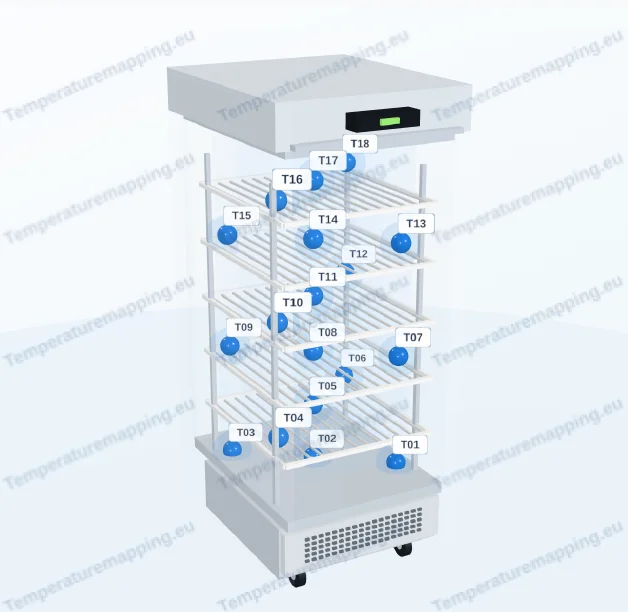
Temperature mapping is a documented study that measures whether every product location inside your pharmacy refrigerator stays within 2-8 °C, and whether the stockroom, counter and dispensing automats stay within the ambient limits stated on the label. The study identifies warm and cold spots, justifies where the routine monitoring probe should sit, and produces the audit-ready dossier that pharmacy inspection visits expect.
In pharmacy inspection reports one requirement returns in every visit: temperature monitoring of storage areas, pharmaceutical refrigerators, pharmacy stock robots and dispensing automats must be demonstrably operational. In the Netherlands, the pharmacy Practice Guideline (Richtlijn Praktijkvoering section 2.4.2.5 and note 23) requires demonstrable control of storage temperature; a mapping study is the accepted way to substantiate this. Three questions follow directly from that.
Without a mapping study, the probe usually sits where the manufacturer placed it, often mid-back at a convenient height. Mapping replaces that with data: the probe moves to the actual worst-case position, or its current position is justified against the mapping graphs.
Every door opening costs stability, and the effect is not evenly spread over the shelves. Mapping quantifies the difference between 08:30 and 12:00 on a busy morning, and between the shelf near the door seal and the shelves lower down. That is where an out-of-specification excursion first appears.
Behind the evaporator plate the local temperature can dip below 2 °C during a defrost cycle. Protein vaccines, insulin and biologics can be silently damaged at sub-zero temperatures, without any visual change to the vial. Mapping shows whether this actually happens under your loading and your thermostat setting.
The three questions above are just the start. Our free audit-readiness check runs your temperature-mapping and monitoring documentation past the control points that pharmacy inspectors actually raise, tailored to your equipment: pharmacy refrigerator, stockroom, dispensing automat or ambient storage. In five to ten minutes you receive a PDF report showing where your file is strong, and where an inspection visit might raise a finding.
Grounded in professional pharmacy practice guidelines, EU GDP up to the pharmacy door, WHO and ISPE, plus 37 concrete findings from 58 Dutch inspection reports.

At Temperature Mapping Europe, your project is handled by people who have worked on both sides: the pharmaceutical quality frameworks that inspections reference, and the practical reality of medicine storage inside a working pharmacy.
We combine hands-on experience in quality management within EU-GMP/GDP environments for pharmaceutical manufacturing and distribution with practical familiarity of how a community or hospital pharmacy actually stores, monitors and dispenses medicines. That means the dossier speaks the language an inspection visit expects, and the measurement setup fits the way your pharmacy actually runs.
The people assessing your fridge, stockroom or dispensing automat come from industry. They understand both the guidance and how temperature mapping is assessed in practice by pharmacy inspectors and internal quality officers.
Temperature Mapping Europe is an independent company, not a manufacturer, distributor or label of any equipment supplier. We sell no monitoring systems of our own and choose data loggers on a brand-neutral basis. Our approach follows ISPE, WHO, GDP, GMP and HACCP guidance, independent of any supplier.
The same person helps define the measurement setup, assesses the fridge or stockroom, processes the data and writes the report. That gives you short lines, fast planning and one fixed point of contact.

The number of loggers, the study duration and the risk zones depend on which storage condition applies to your medicines. Below is the typical scope for pharmacy storage; the exact plan is set in the mapping protocol, on a risk-based rationale per WHO PQS and ISPE GPG.
For vaccines, insulin, biologics, eye drops and other medicines requiring refrigeration. Typical scope for an upright pharmacy fridge: 9 to 18 measurement points across shelves, door zone, back wall and near the evaporator plate, over at least 72 h including a normal opening-hours cycle and a weekend rest.
For products with a labelling statement such as "do not store above 25 °C" or "do not store above 30 °C". Each location (stockroom, counter, night safe or dispensing automat) is treated as its own mapping subject and starts at the WHO baseline of at least 9 loggers, scaling up with volume and complexity. A full ambient sweep of a pharmacy typically runs over at least one full week including a summer weekend.
Measurement points are selected based on how the location is used, which products are stored there, the labelling temperature limit and the question the dossier needs to answer.
A pharmacy mapping dossier should make it clear why the study design was logical, what the data show and how routine monitoring follows from the results.
"The mapping showed our top shelf was one degree warmer during the morning than the sensor position suggested. We moved the probe and reorganised the fridge before the inspection visit."Pharmacist, community pharmacy
Before requesting a quote, use the free 3D mapping tool to sketch your pharmacy refrigerator, stockroom or dispensing automat. You get a proposed sensor layout, an estimated number of loggers and a first indication of the study scope, so the consultation starts with a concrete picture instead of a blank sheet.
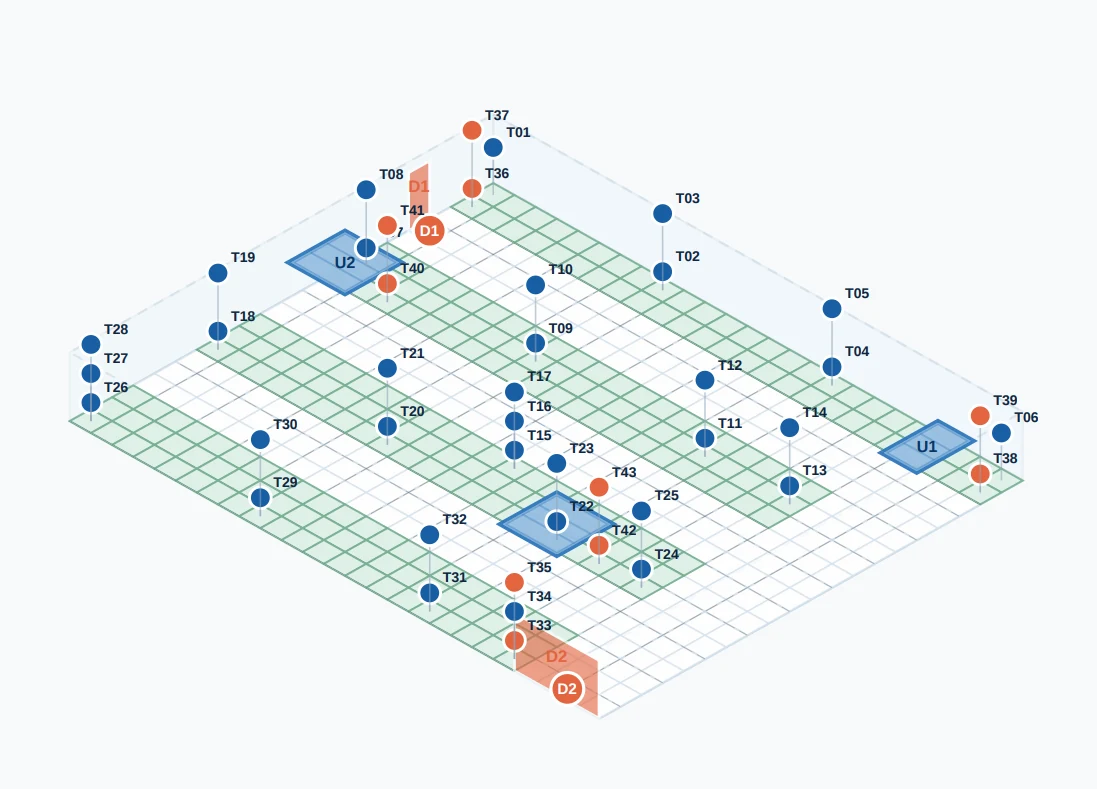
Mapping is especially useful when medicine storage must be demonstrable or when the situation inside the pharmacy has changed.