Essential
Everything you need to get started.
Starting from€299
Included
Get a quote - Data logger rental
- Calibrated data loggers
- Calibration certificates
Preparing for an ISO/IEC 17025 accreditation assessment, an ISO 15189 medical-lab audit, an ISO/IEC 17043 PT provider review or a GMP QC-lab inspection? A temperature mapping study by Temperature Mapping Europe provides the evidence your assessor and quality manager expect, for lab fridges, freezers down to -80 °C, cryogenic vessels, incubators, drying ovens, water baths, thermal blocks and climate chambers.
Laboratory temperature mapping is a documented study that measures whether every sample or reference location inside a lab fridge, freezer, incubator, drying oven, water bath or climate chamber stays within its specified temperature range under real loading. The study identifies hot and cold spots, justifies where the fixed monitoring probe should sit, and provides the evidence an ISO/IEC 17025 or ISO 15189 assessor, an ISO/IEC 17043 PT reviewer or a GMP QC-lab inspector expects to see.
ISO/IEC 17025:2017, ISO 15189:2022 and ISO/IEC 17043:2023 share a common principle: facilities and environmental conditions that can affect laboratory or PT activities must be suitable and appropriately monitored and controlled. The exact requirements and clause structure differ between the standards. In practice, these requirements lead to several useful questions when reviewing temperature-controlled laboratory equipment.
The clause is short, but the burden of proof is not. Without a mapping study, the answer usually falls back on the manufacturer's specification sheet and the internal display reading, which say nothing about the actual sample position. Mapping replaces that with data: the measured distribution across shelves and drawers, the door-open effect during peak use, and a documented conclusion that the storage or analysis condition is met at every use location, with predefined acceptance criteria and, where a statement of conformity is made, a documented decision rule that addresses measurement uncertainty and decision risk.
Incubators, drying ovens and water baths are the classic accreditation trap. Gradients of 1 to 2 K between shelves, between the door zone and the back wall, or between an empty chamber and a loaded chamber are common, and can silently invalidate a microbiological method, a loss-on-drying determination, or a PT item. Mapping quantifies the actual distribution and identifies which positions are safe to use for which methods.
The equipment's factory control sensor is not necessarily located at the position most representative of the stored samples or materials. Mapping can be used to justify the location of a routine monitoring sensor in relation to critical storage or use locations and the temperature distribution identified during the study, and can support the selection of monitoring locations and alarm limits that are relevant to those critical locations.
The three questions above are just the start. Our free audit-readiness check runs your temperature-mapping and monitoring documentation past the review points that ISO/IEC 17025, ISO 15189 and ISO/IEC 17043 assessors, and GMP inspectors, actually examine, tailored to your equipment: lab fridge, freezer, ULT, incubator, drying oven, water bath or climate chamber. In five to ten minutes you receive a PDF report showing where your file is strong, and where an assessor might raise a finding.
Grounded in ISO/IEC 17025:2017, ISO 15189:2022, ISO/IEC 17043:2023, EU GMP Annex 15, WHO and ISPE guidance, plus 37 concrete findings from 58 Dutch GDP/GMP inspection reports.

At Temperature Mapping Europe, your mapping study is handled by people who have worked on both sides: the accreditation and pharmaceutical quality frameworks that assessors reference, and the practical reality of running a fridge, an incubator or a climate chamber inside a working lab.
We combine hands-on experience in quality management within EU-GMP/GDP environments with practical familiarity of ISO/IEC 17025 testing and calibration labs and ISO 15189 medical labs. That means the dossier speaks the language a lead assessor, an internal quality officer and a GMP inspector all expect, and covers the crossover cases where a lab operates under two standards at once.
Every logger is supplied with a calibration certificate from the calibration laboratory used, traceable to national standards through the ILAC-MRA chain. That traceability is what makes the mapping data admissible under clause 6.4 (equipment) and clause 6.5 (metrological traceability) of ISO/IEC 17025.
Temperature Mapping Europe is an independent company, not a manufacturer, distributor or label of any equipment supplier. We sell no monitoring systems of our own and choose data loggers on a brand-neutral basis. Our approach follows ISO, ISPE, WHO, GDP and GMP guidance, independent of any supplier.
The same person defines the measurement setup, assesses the equipment, processes the data and writes the report. That gives you short lines, fast planning and one fixed point of contact from intake to signed dossier.

The number of loggers, the study duration and the risk zones depend on the equipment type, the temperature setpoint, the loading and the method that will be run at that location. Below is our typical risk-based scope for lab-side equipment; the exact plan is set in the mapping protocol, drawing where applicable on the WHO temperature-mapping guidance, the ISPE Good Practice Guide: Controlled Temperature Chambers, Commissioning and Qualification, Mapping and Monitoring (Second Edition), DIN 12880 for heating ovens and incubators, and DKD-R 5-7 for climatic chambers.
For reagents, standards, calibrators, controls, patient samples, blood products, cell banks, biobank materials and PT items awaiting dispatch. Our typical risk-based scope for a lab fridge or -20 °C freezer uses 9 to 15 measurement points across shelves and drawers, the door zone, the back wall and near the evaporator plate, over at least 72 hours, including a representative working day. ULT -80 °C freezers and cryogenic vessels get extra points at rack, box and door level, with attention to defrost cycles and vapour-phase gradients.
For microbiological incubation, cell culture, sterility testing, loss-on-drying, gravimetric determinations, sample conditioning, viscosity baths, thermal-block assays and climate-chamber method testing. Our typical risk-based scope for an incubator or drying oven uses a measurement layout appropriate to the equipment and intended use; where DIN 12880:2007-05 is specifically applied, its prescribed measurement arrangement is followed. For climate chambers, empty and representative loaded mapping studies may form part of OQ and/or PQ, depending on the intended use and qualification strategy.
Measurement points are selected based on how the equipment is used, what stays inside it, the method requirement and the question the dossier needs to answer for the assessor.
A laboratory mapping dossier should make it clear why the measurement design was logical, how the method or storage requirement drives the acceptance criteria, what the data show under real loading, and how routine monitoring follows from the results. That chain gives an assessor, reviewer or inspector a clear basis for evaluating the study and its conclusions.
"The mapping showed that our top-shelf incubator position sat one full degree above the display value. We moved the plates to the qualified shelves and updated the SOP before the accreditation visit."Illustrative example, medical laboratory
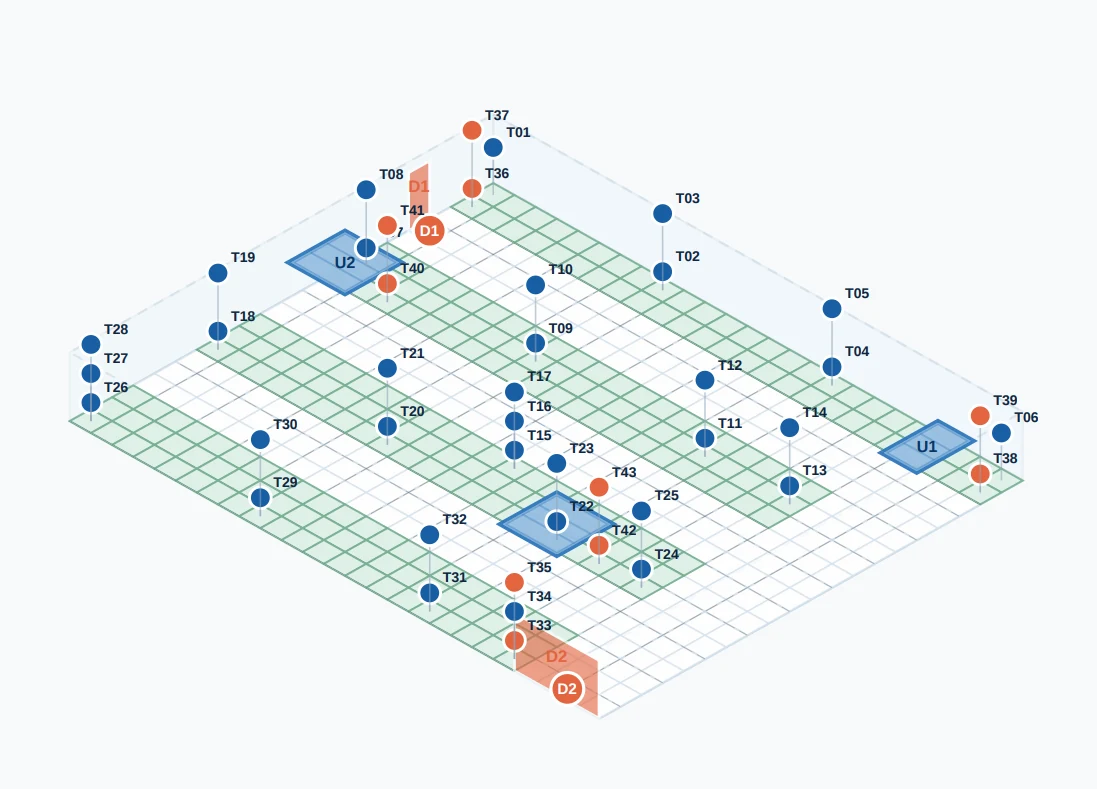
Before requesting a quote, use the free 3D mapping tool to sketch your lab fridge, freezer, incubator or climate chamber. You get a proposed sensor layout, an estimated number of loggers and a first indication of the study scope, so the consultation starts with a concrete picture instead of a blank protocol page.
Temperature mapping should be considered within the equipment lifecycle. The need for repeat mapping should be reviewed following relevant changes, adverse performance trends or other risk-based triggers.